

page-header-img

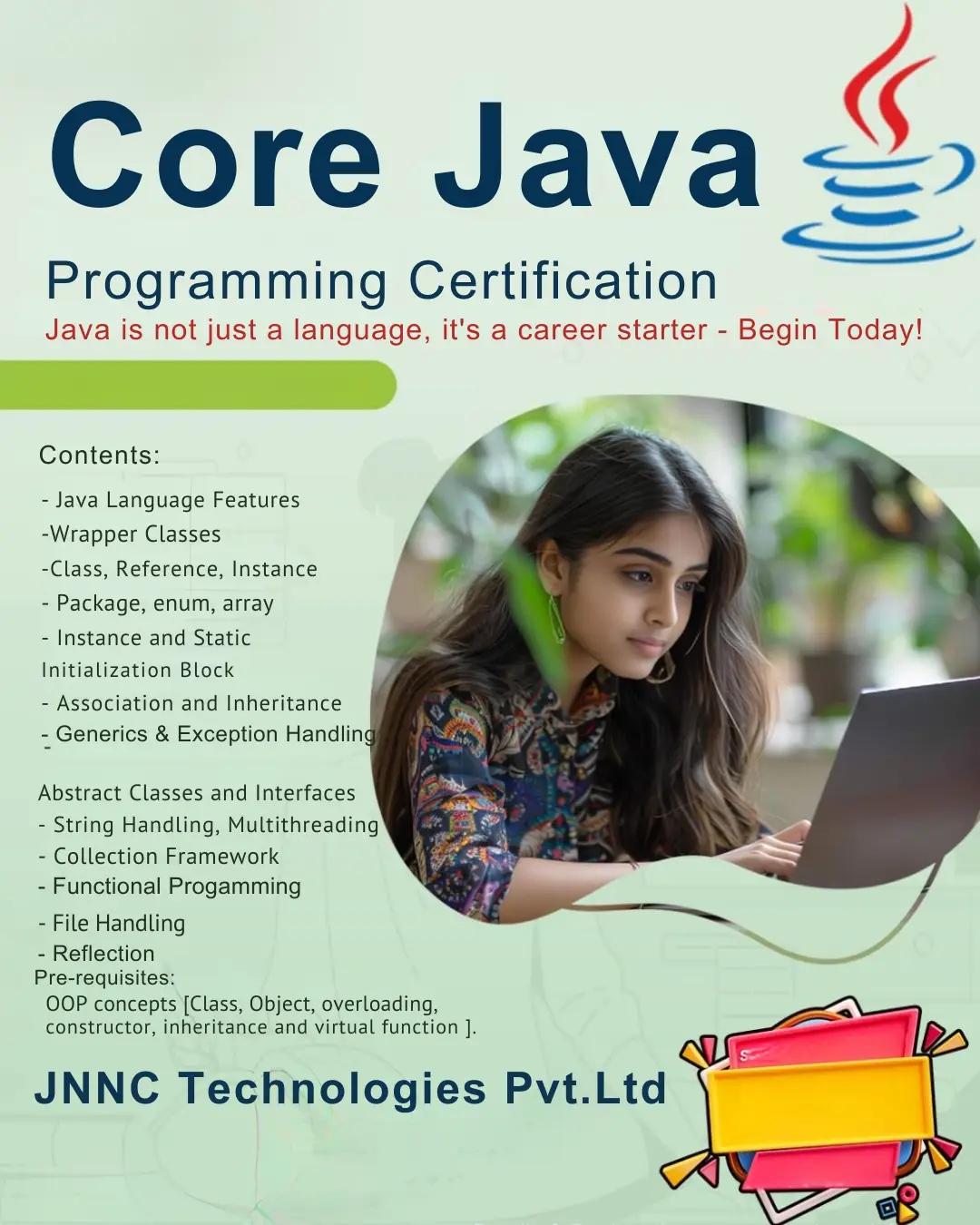
Corejava

Do you aspire to master java programming? Choosing JNNC Technologies is the finest move. The best practical Java experience is what we offer. Our instructors are highly knowledgeable java professionals and subject-matter experts. It doesn’t matter if you want to develop a new talent or are a beginner. Corejava training in Vizag.We provide the most thorough educational programs to aid in your professional development.

Syllabus

Java introduction

Java, released by Sun Microsystems in 1991. Among the programming languages Java arise as the industry leader. Corejava training in Vizag Java is very versatile and can be used for numerous applications ranging from complex enterprise software systems to creating interactive web features and even developing mobile applications. This is actually the backbone of Java’s success story, showing the language’s amazing ability to adapt and thrive in the ever-changing tech world.
 

It is used for the development of Internet of Things, APIs, e-commerce websites, financial trading platforms, scientific applications and a lot more. Java provides more security than other programming languages because of which most of the banking websites are developed in advanced java programming. Java provides power to develop android websites. If you are willing to learn java, then you can easily learn any programming language. 

Core java Training in Vizag

Benefits of Java Full Course Training

Java is very versatile as it is used for programming applications on the web, mobile, desktop, etc. using different platforms. Also, Java has many features such as dynamic coding, multiple security features, platform-independent characteristics, network-centric designing, etc. Corejava training in Vizag that make it quite versatile.

Completing a Java full course is a good step towards gaining the skills required for a job in Java development, but whether it’s enough depending on various factors, Like Hands-on experience and live project-based working knowledge,Corejava training in Vizag So JNNC Technologies Provides Interactive Classes with Live Projects.


Core java Training in Vizag.


Syllabus

Core Java Programming - Introduction of Java
  • Introduction to Java  
  • Features of Java
  • Comparison with C and C++
  • Download and install JDK/JRE (Environment variables set up)
  • The JDK Directory Structure
  • First Java Program through command prompt
  • First Java Program through Eclipse
Data types and Operators
  • Primitive Datatypes, Declarations, Ranges
  • Variable Names Conventions
  • Numeric Literals, Character Literals
  • String Literals
  • Arrays(One dimensional; two- dimensional)
  • Array of Object References
  • Accessing arrays, manipulating arrays
  • Enumerated Data Types
  • Non-Primitive Datatypes
  • Defining a class, variable and method in Java
  • Method Signature; method calls
  • Expressions in Java; introduction to various operators
  • Assignment Operator
  • Arithmetic Operators
  • Relational Operators
  • Logical Operators
  • Conditional Operators
  • Operator Precedence
  • Strict typing
Control Flow statements
  • Statements and it’s various categories in Java
  • If, if-else, if-else-if
  • Switch case
  • For statement (both flavours traditional and enhanced for)
  • While and do-while loops
  • The continue Statement; labelled continue statement
  • The break Statement; labelled break statement
  • Return statement
OOPS and its application in Java
  • Classes and Objects
  • Defining a class;Defining instance variables and methods
  • Creating objects out of a class
  • Method calls via object references
  • Abstraction
  • Interfaces and Abstract classes
  • Abstract and non-abstract methods
  • Inheritance
  • Extends and implements keywords in Java
  • Super class and Sub class
  • This keyword, super keyword in Java for inheritance
  • Polymorphism
  • Compile time polymorphism — Overloading of methods
  • Run time polymorphism — Overriding of methods
  • Method Overriding rules and method overloading rules
  • Introduction to Object class and it’s methods
  • Encapsulation
  • Protection of data
  • Java Bean, POJO
  • Getters/Setters
Packages
  • Need for packages
  • What are packages; package declaration in Java
  • Import statement in Java
  • How do packages resolve name clashes?
Miscellaneous
  • Var-Args
  • Memory allocations to variables
  • Double equals operator(==) operator for primitives and objects
  • toString() method on an object
Statics
  • Static variables and methods
  • Static imports
  • Static initialization blocks; instance initialization blocks
  • Static concept in inheritance
Constructors
  • What are Constructors?
  • Properties of Constructors
  • Default and Parameterized Constructors
  • Rules for constructor implementation
  • this call; super call for constructors
  • Constructors concept for Abstract classes and interfaces
Exceptions in Java
  • What are Exceptions?
  • Need for exceptions
  • How can Exceptions be coded in Java?
  • API hierarchy for Exceptions
  • Types of Exceptions
  • Keywords in Exception API: try, catch, finally, throw, throws
  • Rules for coding Exceptions
  • Declaring Exceptions
  • Defining and Throwing Exceptions
  • Errors and Runtime Exceptions
  • Custom Exception
Strings in Java
  • What are Strings?
  • Method APIs on String; operations on Strings
Collection Framework in Java
  • The Collections Framework
  • The Set Interface
  • Set Implementation Classes
  • The List Interface
  • List Implementation Classes
  • The Map Interface
  • Map Implementation Classes
  • Queue Interface
  • Queue Implementation classes
  • Utility classes
  • Sorting collections using utility methods
  • equals() and hashCode contract in Java collections
  • Overriding equals and hashCode methods in Java
  • New Collections added in Java 1.6
  • Primitive wrapper classes and all its method APIs
Input-Output in Java
  • Reading User input from console
  • PrintWriter Class
Threads in Java
  • Threaded Applications
  • Process based multitasking Vs Thread based multitasking
  • Thread API in Java
  • Creating Threads
  • States of a Thread
  • Synchronization for threads; static and non-static synchronized methods; blocks; concept of object and class locks
  • Coordination between threads – wait, notify and notifyAll methods for inter-thread communication
Access Modifiers in Java
  • What are access modifiers?
  • Default
  • Protected
  • Private
  • Public
Hibernate framework Spring
  • Introduction to Spring and Dependency Injection
  • Understanding Dependency Injection
  • Setting Up
  • Understanding Spring Bean Factory
  • Writing Code Using the Bean Factory
  • Application Context and Property Initialization
  • Using Constructor Injection
  • Injecting Objects
  • Inner Beans, Aliases and idref
  • Initializing Collections
  • Bean Autowiring
  • Test Title
  • Scopes and Life Cycles
  • Understanding Bean Scopes
  • Using ApplicationContextAware
  • Bean Definition Inheritance
  • Lifecycle Callbacks
  • Writing a BeanPostProcessor
  • Coding To Interfaces
Annotations and Event Handling Annotations
  • @Required
  • @Autowire
  • @PostConstruct
  • @PreDestroy
  • @Qualifier
  • @Resource
  • @Component
  • @Service
  • @Named
  • Various Annotation based Post Processor
  • AutowiredAnnotationBeanPostProcessor
  • PersistenceAnnotationBeanPostProcessor
  • RequiredAnnotationBeanPostProcessor
  • Introduction to Annotations and the Required Annotation
  • Some JSR-250 Annotations
  • Component and Stereotype Annotations
  • Using MessageSource To Get Text From Property Files
  • Event Handling in Spring
Spring boot
  • Spring Boot and Spring Data
  • Spring and Web Services
  • Data access with Spring
  • Object Relational Mapping
  • Enterprise Information Connectivity
  • •    Introduction to Spring Boot and Dependency Injection
    •    Understanding Dependency Injection 
    •    Setting Up 
    •    Understanding Spring boot Bean Factory 
    •    Writing Code Using the Bean Factory 
    •    ApplicationContext and Property Initialization 
    •    Using Constructor Injection 
    •    Injecting Objects 
    •    Inner Beans, Aliases and idref 
    •    Initializing Collections 
    •    Bean Autowiring 
    •    Test Title 
    •    Scopes and Lifecycles
    •    Understanding Bean Scopes 
    •    Using ApplicationContextAware 
    •    Bean Definition Inheritance 
    •    Lifecycle Callbacks 
    •    Writing a BeanPostProcessor 
    •    Coding To Interfaces 
    •    Annotations and Event Handling
    •    Introduction to Annotations and the Required Annotation 
    •    Some JSR-250 Annotations 
    •    Component and Stereotype Annotations 
    •    Using MessageSource To Get Text From Property Files 
    •    Event Handling in Spring boot

    •    Spring Boot and Spring Data
    •    Spring Boot and Web Services
    •    Data access with Spring
    •    Object Relational Mapping
    •    Enterprise Information Connectivity
    •    Spring boot Security

Leave a Reply

Your email address will not be published. Required fields are marked *

error: Content is protected !!
Call Us